Personal Assistant Duties: the Full List of What a PA Actually Does
A good personal assistant takes hundreds of small things off your plate every week. A poorly defined one adds them: some things get done, some get lost, and there's no one to hold to account. The difference isn't the person — it's how clearly their duties are drawn.
A vague "help me with life" works right up to the first crunch. So below is the full breakdown of what a personal assistant's duties include, a ready checklist, and the thing that matters more than any skill. This isn't about one job posting — it's about the role itself. Take it as a base and adjust it to fit.
A personal assistant (PA) is someone who runs an employer's day-to-day affairs: planning the day, running errands, organising travel, purchases and the home, and keeping an eye on payments and deadlines. Their job is to free up your time and attention by taking the routine off your hands.
It helps to picture an assistant as the "operating system" of your day: you set a task at the top level, and they take on all the small steps so it actually gets done.
What a personal assistant does: 8 areas of responsibility
1. Scheduling and the calendar
The assistant holds the schedule and makes sure you miss nothing: meetings, calls, deadlines, birthdays. They agree the day's plan the evening before, set priorities, and warn you in advance about what's coming up. The result: no nagging "don't forget" list in your head.
2. Errands and purchases
Buy, order, find, collect, return. From groceries and gifts to sourcing a contractor or a rare part. A good assistant logs errands so nothing slips, and reports progress on big tasks without waiting to be asked.
3. Travel and logistics
Tickets, hotels, transfers, routes, bookings. The assistant pulls the whole trip into one piece and keeps confirmations and backup options handy in case of cancellations. This also covers timing the car and coordinating the driver.
4. Home and household
Call a repairman, take a delivery, oversee the cleaning, restock supplies, and stay on top of deadlines (insurance, car service, contract renewals). The assistant is the link between you and everyone who does something around the house.
5. Money and payments
Recurring payments, paying bills, small cash purchases. Here transparency matters: expenses are logged with a receipt, and cash issued is kept on account. This isn't about distrust — it's about order, so at the end of the month it's clear where the money went. More on this in the piece on expense control.
6. Documents and personal data
The assistant keeps documents, contracts and access in order and reminds you of deadlines. The more trust, the higher the bar for accuracy and security: a family's personal data is a responsibility, not just a folder of files.
7. Communication and meetings
Receive and filter messages, arrange meetings, brief guests, handle routine correspondence. The assistant takes the flood of small approvals off you, leaving only what genuinely needs your decision.
8. Confidentiality
Possibly the most important one. The assistant sees your life from the inside — money, contacts, plans, family. Staying silent about the employer's affairs, posting nothing online and discussing nothing with outsiders is a basic rule worth stating from day one. Some sensitive contacts can even be hidden under a cover name, so the assistant manages a person without knowing who they really are.
A ready checklist of duties
A short version you can use as the base of a job description:
| Area | What it covers |
|---|---|
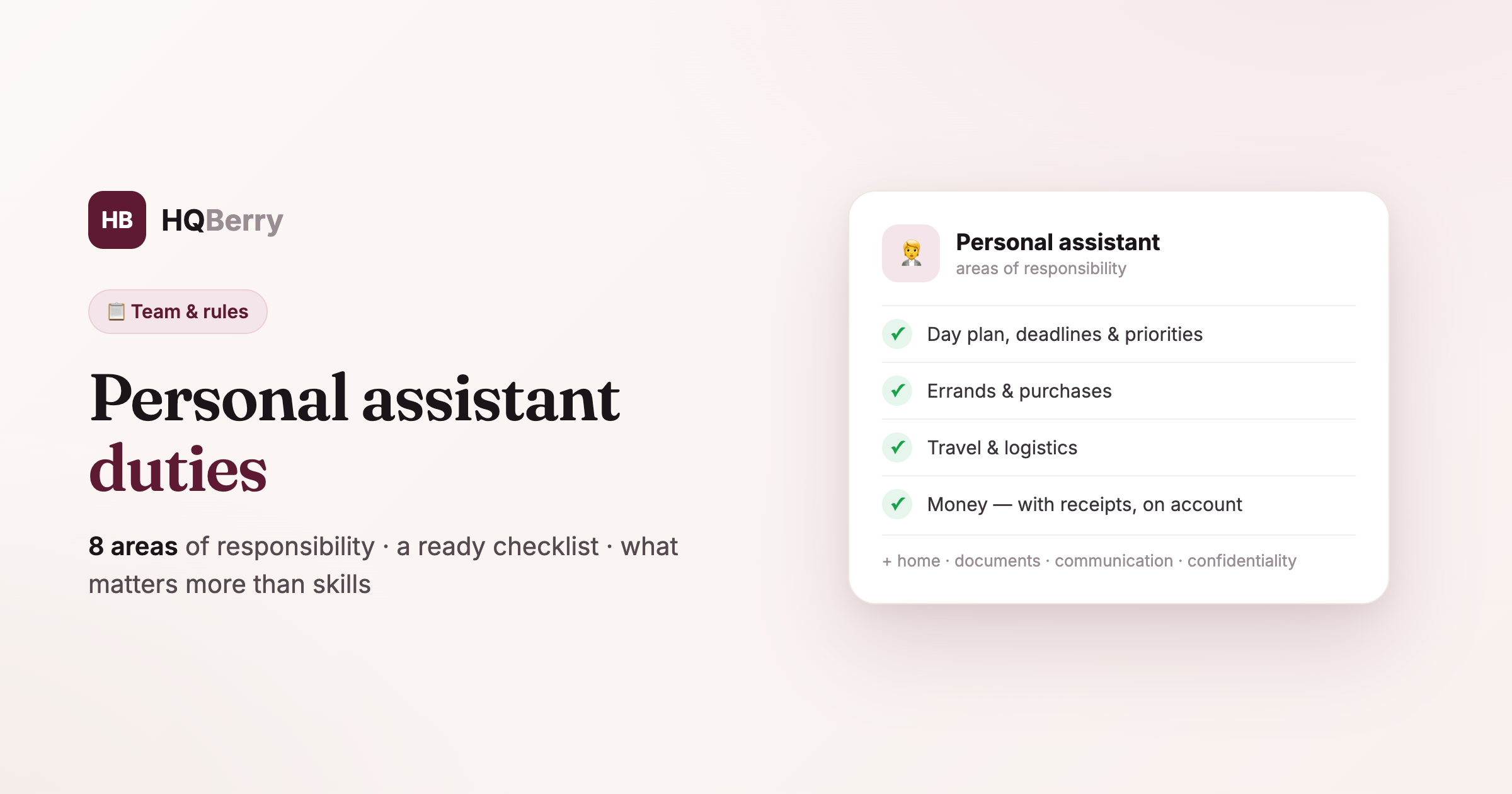
| Day & calendar | Day plan, reminders, priorities, deadlines |
| Errands | Buy / order / find / collect, progress reports |
| Travel | Tickets, hotels, transfers, routes, backups |
| Home | Repairs, deliveries, supplies, deadlines (service, insurance, contracts) |
| Money | Payments, cash purchases — with receipts, on account |
| Documents | Order, access, deadline reminders |
| Communication | Message filtering, arranging meetings and guests |
| Confidentiality | Silence on family matters, data security |
What matters more than skills: 5 qualities of a good assistant
Specific skills (planning, correspondence, organising travel) are picked up in a couple of weeks. These aren't:
- Reliability. Said "I'll have it by Friday" — had it by Friday. Without reminders.
- Seeing things through. Not "I sent the request", but "the matter is resolved".
- Calm under pressure. Flight cancelled, repairman a no-show — the assistant doesn't panic, they propose a solution.
- Proactivity. Spots a problem before you do and closes it while it's small.
- Confidentiality. What they learn on the job stays with them.
When hiring, check exactly this — a résumé with "confident PC user" doesn't help here.
How to lock in the duties so they actually work
The most common mistake is keeping duties in your head and stating them out loud. A week later it turns out half of it was understood differently. So:
- Write the duties down — as a short job description. Once, and there's nothing left to argue about with "I didn't know".
- Keep day-to-day tasks in one place — with a clear deadline and a "done / in progress" status. Then you don't have to hold it all in your head and keep asking.
- Make money transparent — expenses with a receipt, cash on account.
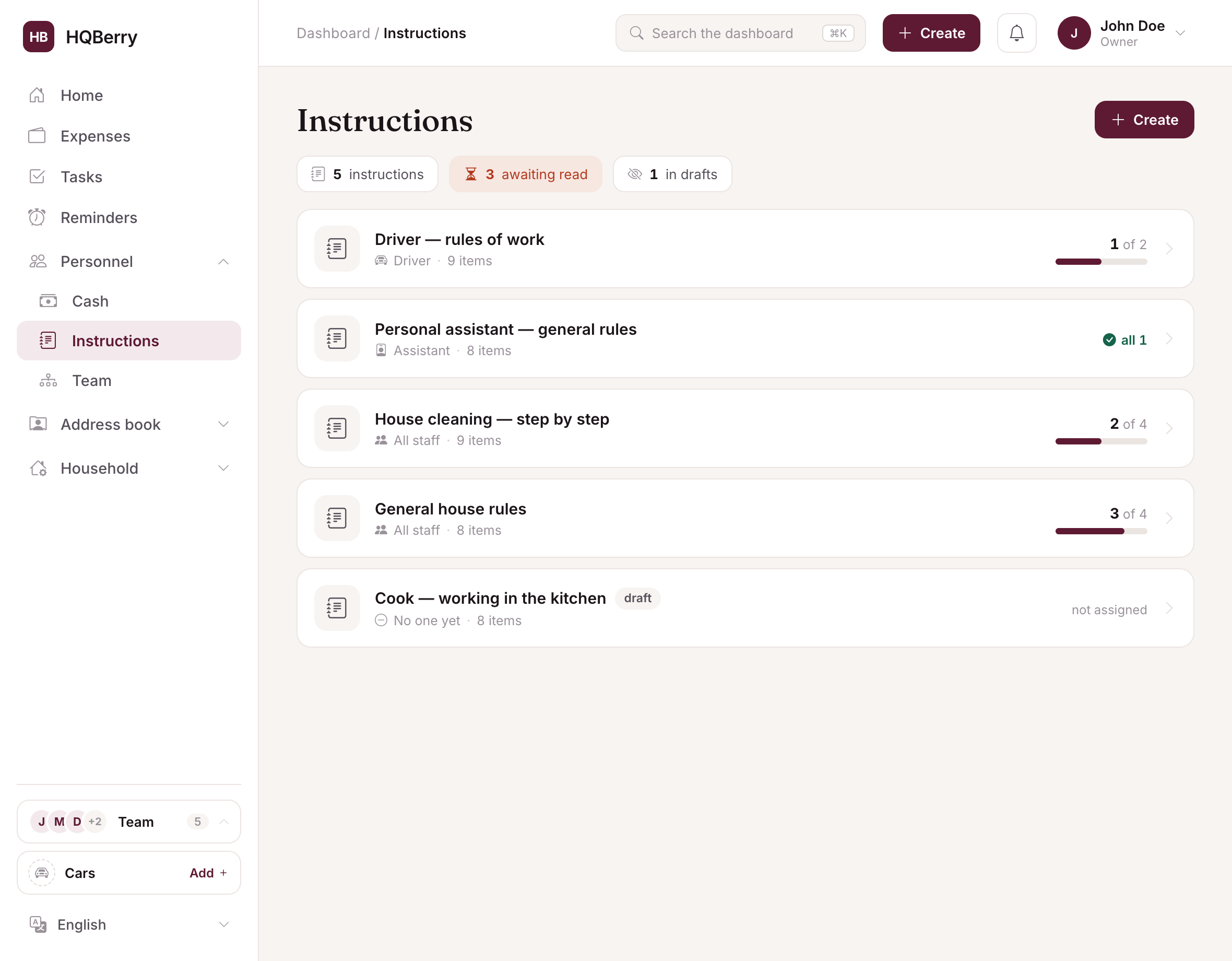
That's exactly what HQBerry is for: you set the rules and tasks up once, the assistant works by them — and you simply watch that everything's on track.
Frequently asked questions
How is a personal assistant different from a secretary or an executive assistant? A secretary and an executive assistant work in the office and mostly on business tasks. A personal assistant also runs the employer's personal affairs — the home, travel, family, payments — and their remit is broader and more trusted.
What should a good personal assistant be able to do? The main thing isn't specific skills but reliability: see a task through, keep their word on deadlines, not lose their head in unexpected situations, and keep things confidential. The technical abilities are picked up along the way.
How do I set tasks for an assistant so nothing gets lost? Write the duties down (a job description), and keep day-to-day tasks in one place with clear deadlines and a "done / not done" status. Then you don't have to hold it all in your head and keep asking.
Does a personal assistant need a job description? Yes. It sets a single standard of work, removes "I didn't know" disputes and helps bring a new person up to speed quickly. A short, clear list of duties is enough — not a multi-page document.
Can I trust an assistant with money and personal data? You can, if the rules are in place: cash kept on account and with receipts, access to data on a need-to basis, and sensitive contacts hidden. Trust is built on transparency, not on blind faith.